“The book serves as a powerful inspiration for readers to follow their own curiosity and explore the vast, unknown parts of our planet. Sullivan and Rosen have created an outstanding piece of narrative nonfiction, offering a unique perspective from an unparalleled explorer....Essential for any collection....”
—★ starred review, School Library Journal
"This handsome and compelling offering has multiple applications, ranging from extreme exploration to women in STEM, and is sure to enchant aspiring adventurers."
—★ starred review, Booklist
—★ starred review, School Library Journal
"This handsome and compelling offering has multiple applications, ranging from extreme exploration to women in STEM, and is sure to enchant aspiring adventurers."
—★ starred review, Booklist
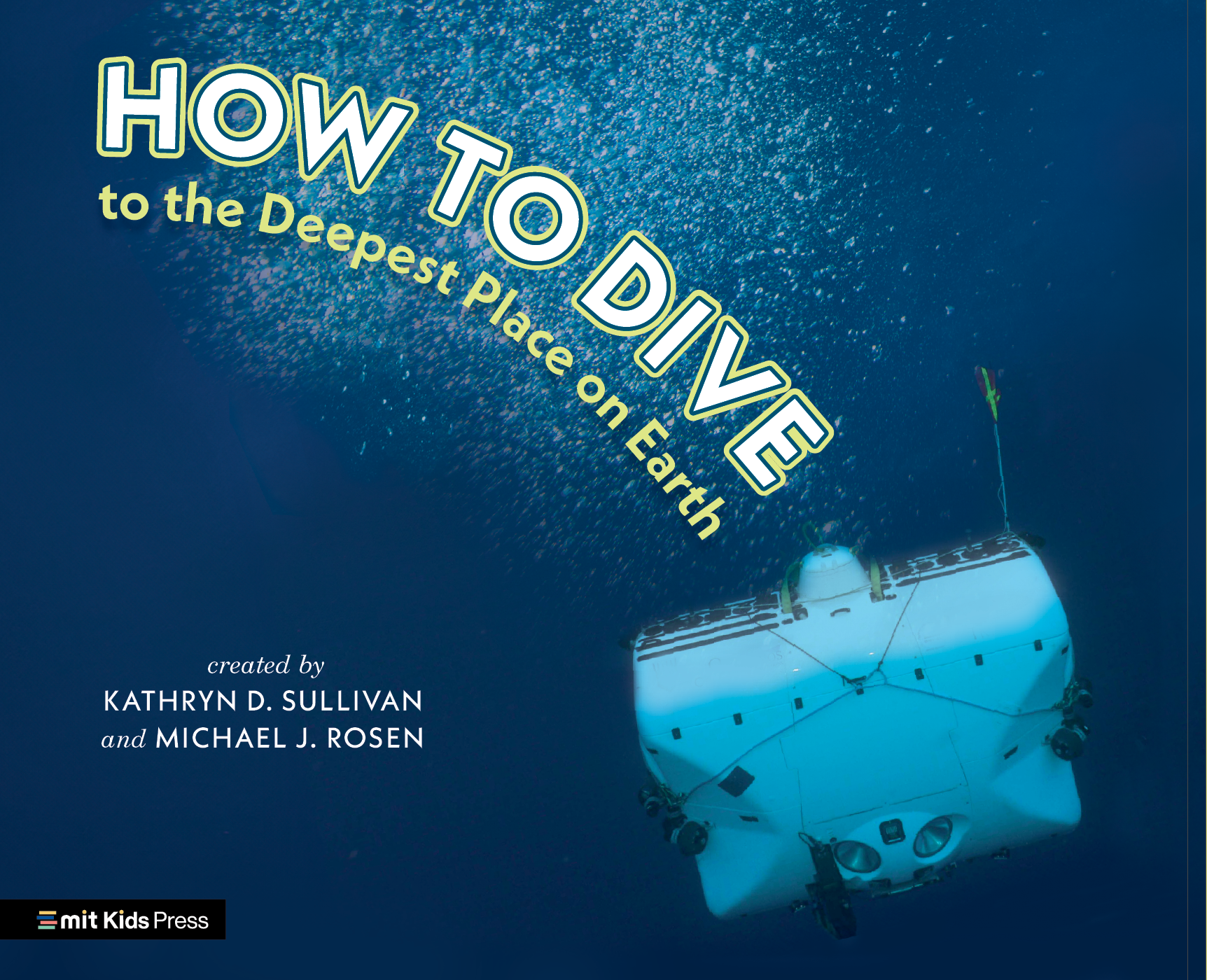
How to Dive to the Deepest Place on Earth invites young readers (ages 7–11) to join astronaut and oceanographer Kathryn D. Sullivan on her four-hour descent to the bottom of the Mariana Trench in a two-person submersible. Blending firsthand narrative with clear science, the book reveals how light, pressure, temperature, and life itself change as humans travel nearly seven miles below the ocean’s surface.
Most STEM books about the ocean present facts by category—animals, depths, or technology. This book is structured as a single continuous journey, allowing readers to experience science as it unfolds in real time: light fading, pressure increasing, and life adapting zone by zone. It is also unusual in that the narrator is a scientist who has traveled both into space and to the deepest place on Earth, giving the book a rare perspective on exploration in two extreme environments.
Most STEM books about the ocean present facts by category—animals, depths, or technology. This book is structured as a single continuous journey, allowing readers to experience science as it unfolds in real time: light fading, pressure increasing, and life adapting zone by zone. It is also unusual in that the narrator is a scientist who has traveled both into space and to the deepest place on Earth, giving the book a rare perspective on exploration in two extreme environments.
Kathryn D. Sullivan is often called “the most vertical person in the world”—the first American woman to walk in space and the first woman to descend to the deepest point in the ocean. Her story shows children that exploration is not a single dramatic moment, but a lifetime of curiosity, preparation, and persistence.
48 pages, illustrated with photographs and with illustrations by Michael J. Rosen
ISBN $19.95